
WELCOME BONUS 300%
UP TO €2000 + 100
FREE SPINS
UP TO €2000 + 100
FREE SPINS
Home → Blackjack
Blackjack at Christchurch Casino
Stop the Session After a 30 Percent Loss
Late surrender in blackjack cuts the house edge by 0.08 percentage points, because the player folds after the dealer checks for blackjack and receives 50% of the stake back. That modifier sits between the single-deck figure of 0.15% and the 0.46% of the six-deck basic-strategy game, so the same rule matters more on tighter rulesets. On a €100 stake the surrender returns €50 instead of risking the full amount.
Insurance pays 2:1 but carries an RTP of 92.53% and a house edge of 7.47%, so a €100 side bet loses €7.47 on average per resolved hand. Basic strategy always declines it, except for card counters at a true count of +3 or higher, where the edge briefly turns positive. A single-deck game lowers that insurance edge to roughly 5.88%, still far above the main game.
A 6:5 blackjack payout instead of 3:2 lifts the house edge by exactly 1.39 percentage points, from 0.46% to 1.85%. On a €10 bet a blackjack pays €12 rather than €15, a €3 shortfall on every natural. The 6:5 rule therefore costs more than any single rule change and overwhelms the 0.08-point gain from late surrender.
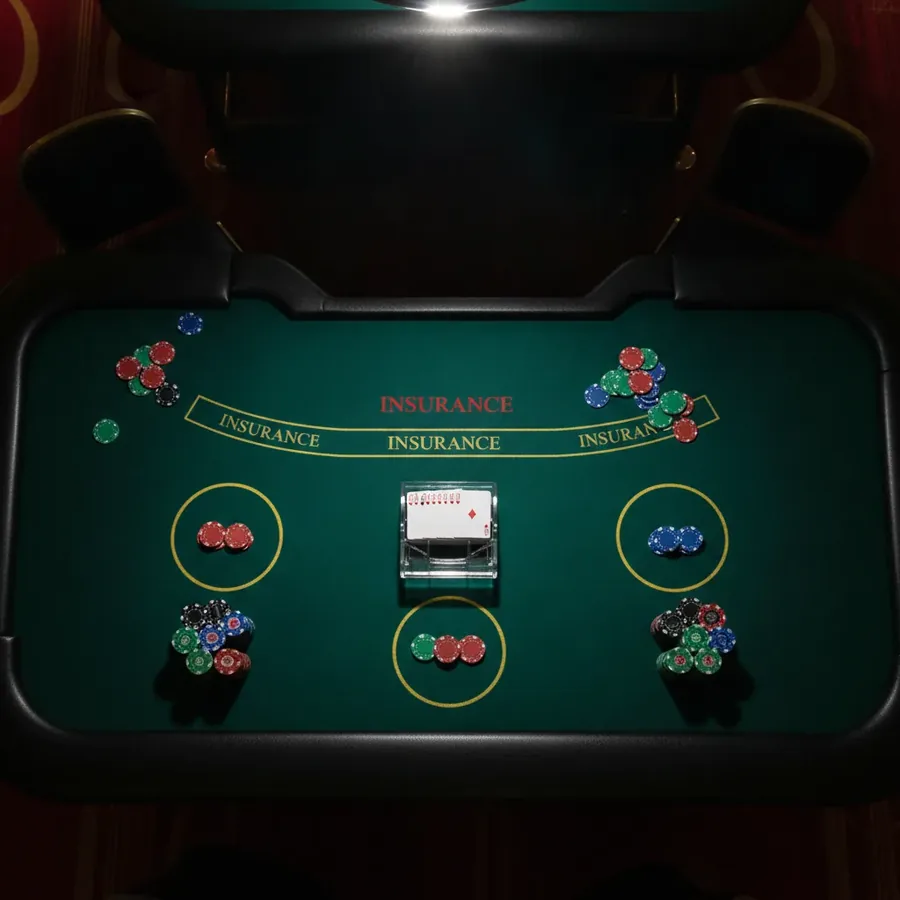
The Insurance Mistake: 7% Extra House Edge
Insurance in blackjack carries a house edge of 7.47% with 6 to 8 decks, which is roughly 7 percent more than the main game. Blackjack 6 decks, S17, DAS, DOA with a 3:2 payout holds only 0.46%, so the side bet is more than sixteen times as expensive for the player. The separate bet of up to 50% of the main bet is offered when the dealer shows an ace.
The 7.47% edge means that 100 EUR staked on insurance loses 7.47 EUR on average in the long run. Basic strategy always declines the bet, except for card counters at a true count of +3 or higher. Insurance pays 2:1, but the payout does not compensate for the probability of the dealer completing blackjack.
The comparison with Blackjack Liberal Vegas Strip is instructive: the main game has an RTP of 99.72% and a house edge of 0.28%. Taking insurance repeatedly pushes the effective cost of a session far above that figure, because the side bet resolves independently of the player's own hand. With a single deck the edge would be about 5.88%, still worse than any main-game rule in the list.
Double Down or Just Hit on 11
Doubling down on 11 under the 6-deck rule set with S17, DAS, DOA and 3:2 payout allows the player to stake twice the original bet and receive exactly one card. The house edge for this game is 0.46% when basic strategy is followed, and the double on 11 is a core component of that strategy. The rule DOA permits doubling on any first two cards.
A simple hit on 11 takes one card without increasing the stake, while a double down commits 2x the bet with the same single card. On a 10 EUR bet, doubling raises the stake to 20 EUR and the payout for a regular win remains 1:1. The Liberal Vegas Strip variant with RTP 99.72% also includes DAS, so doubling after a split is allowed there.
The effect of DAS is a house edge reduction of about 0.14 percentage points, which is directly relevant when a split produces a total of 11 on either new hand. Blackjack Surrender, by contrast, improves RTP by about 0.08 percentage points and is a separate decision. The player should compare both options against the variant's full rule set before staking 2x on 11.
Calling Late Surrender Correctly in Three Steps
Step one is to confirm that the dealer has checked for blackjack, because late surrender is only available after that check. Blackjack Surrender improves RTP by about 0.08 percentage points and returns 50% of the stake. On a 20 EUR bet, the player receives 10 EUR back and loses the other 10 EUR.
Step two is to apply the rule only under the variants that list it: Blackjack Surrender and Blackjack Liberal Vegas Strip. The Liberal Vegas Strip rules set shows RTP 99.72% with a house edge of 0.28%, and late surrender is part of that combination. The 6-deck S17, DAS, DOA game has no surrender, so the option does not exist there.
Step three is to register the effect on the expected loss: minus 0.08 percentage points of house edge equals 0.08 EUR saved per 100 EUR staked. Early surrender would be worth much more, up to 0.6 percentage points, but is extremely rare. The three steps therefore isolate the exact moment when the option becomes available and the exact price of using it.
When Can You Raise Your Bet?
The bet can be increased through a double down under the DOA rule in Blackjack 6 decks, S17, DAS with 3:2 payout, where the stake is multiplied by 2 and one card is dealt. The house edge is 0.46% with basic strategy, and the double is a mathematically justified increase on totals such as 11 against a weak dealer card. The staked amount rises from the original bet to 2x that amount.
A split also increases the total at risk, because the player may create up to 4 hands and each split hand receives its own stake. Split aces usually get one card each. The rule effect for resplitting aces is minus 0.08 percentage points of house edge, while DAS is worth about minus 0.14 percentage points, so the increase is less costly under those rules.
The live tables show the bet ranges within which increases occur: Infinite Blackjack by Evolution accepts 1 to 5,000 EUR and Lightning Blackjack accepts 1 to 2,500 EUR. Blackjack Party by Evolution runs from 1.00 to 1,000 EUR. Any increase must stay inside the selected table's range and respect the rule set of the variant, including whether surrender is available.
Blackjack variants at a glance
| Variant | Payout | House edge | Rule | RTP |
|---|---|---|---|---|
| Blackjack Liberal Vegas Strip (liberal rules, 3:2) | Blackjack 3:2, win 1:1 | 0.28% | The most player-friendly rule set: S17 + DAS + resplit + late surrender. Standard deviation 1.15 | 99.72% |
| Blackjack 6:5 payout instead of 3:2 (6 decks) | Blackjack 6:5, win 1:1 | 1.85% | Replacing 3:2 with 6:5 adds exactly +1.39 percentage points to the casino's edge – more than any other rule change. On a €10 bet a blackjack pays €12 instead of €15. | 98.15% |
| Blackjack 6 decks, S17, DAS, DOA, 3:2 payout, basic strategy | Blackjack 3:2, regular win 1:1, insurance 2:1 | 0.46% | Dealer stands on soft 17; double down on any first two cards; doubling after a split allowed; no surrender. Basic strategy is required to reach this figure | 99.54% |
| Blackjack Insurance (6–8 decks) | Insurance 2:1 | 7.47% | Separate side bet of up to 50% of the main bet when the dealer shows an ace. Basic strategy ALWAYS declines it (except for card counters at a true count ≥ +3). With a single deck the edge is ≈ 5.88% | 92.53% |
| Blackjack Split / double / H17 – rule effects | Double – stake ×2 with one card; split – up to 4 hands; split aces usually get one card each. | H17 +0.22 percentage points; RSA −0.08 percentage points; DAS −0.14 percentage points | Dealer hitting soft 17 lowers RTP by 0.22 percentage points; resplitting aces improves it by 0.08 percentage points; doubling after a split improves it by about 0.14 percentage points; 6 decks instead of 8 – about 0.02 percentage points. | n/a (rule modifiers) |
| Blackjack Surrender (late surrender) – rule effect | 50% of the stake returned | −0.08 percentage points | The player gives up the hand after the dealer has checked for blackjack and loses half the stake. Improves RTP by about 0.08 percentage points. Early surrender is worth much more (up to −0.6 percentage points) but is extremely rare. | n/a (rule modifier) |
Soft 17 Hit vs Stand: 0.22 Percent
A dealer who hits soft 17 lowers the return by 0.22 percentage points, and that single rule change is worth more than several deck adjustments combined. The house edge is the average share of each stake that the casino keeps, so the same game pays 0.22% less per round when the dealer must draw on soft 17.
Six decks instead of eight moves the edge by only about 0.02 percentage points, roughly a tenth of the soft 17 effect. Doubling after a split improves the return by about 0.14 percentage points and resplitting aces by 0.08 percentage points, so neither offsets a hit-soft-17 rule on its own.
On 100 € of stakes the difference between the two rule sets is about 0.22 €, and across 1,000 rounds at 10 € per round it is roughly 22 €. The strongest counterweight is a liberal rule set such as S17 with doubling after a split, resplitting and late surrender, which reaches an RTP of 99.72% and a house edge of 0.28%.
What the Peek Means When the Dealer Shows an Ace
When the dealer shows an ace, the house checks the hole card for blackjack before the player acts, and insurance costs up to 50% of the main bet. Insurance pays 2:1, but it carries an RTP of 92.53% and a house edge of 7.47% on the side bet itself.
Basic strategy always declines insurance, and the edge is even clearer with a single deck at about 5.88%. On a 100 € main bet the insurance stake can reach 50 €, and a 2:1 win returns 100 € on that side bet while a loss costs the whole 50 €.
Card counters take it only at a true count of +3 or higher, which is the exception rather than the routine. Late surrender is the cheaper way to cut losses: giving up the hand after the dealer checks for blackjack returns 50% of the stake and improves the return by about 0.08 percentage points.
One Deck vs Eight Decks: The House Edge Gap
A single deck with classic rules and a 3:2 payout returns 99.85% with a house edge of 0.15%, and one deck is worth about 0.48 percentage points compared with eight decks. The six-deck S17 game with doubling after a split reaches an RTP of 99.54% and a house edge of 0.46%.
On 100 € of stakes the single-deck game costs about 0.15 € on average against about 0.46 € for the six-deck version. The Blackjack 6:5 payout instead of 3:2 returns 98.15% with a house edge of 1.85%, adding exactly 1.39 percentage points and wiping out the deck advantage several times over.
A 10 € blackjack pays 12 € at 6:5 rather than 15 € at 3:2, so the single-deck saving of about 0.48 percentage points is lost unless the 3:2 payout is retained. The strongest rule set remains liberal Vegas Strip at 99.72% RTP and 0.28% house edge, with a standard deviation of 1.15.
What a Natural Blackjack Actually Pays
A natural blackjack pays 3:2 under classic rules, so a €100 stake returns €150 in profit, while the same hand at a 6:5 table returns only €120. That gap of €30 on one hand equals exactly the 1.39 percentage points that replacing 3:2 with 6:5 adds to the casino's edge, the largest single rule change on the blackjack table. On a €10 bet the difference is smaller in absolute terms but identical in proportion: €12 at 6:5 against €15 at 3:2.
Blackjack Single deck with classic rules carries an RTP of 99.85% and a house edge of 0.15%, the lowest edge on the blackjack table. Fewer decks lower the edge, and one deck gives about −0.48 percentage points compared with eight decks, but that advantage is often cancelled by a 6:5 payout instead of 3:2. A player who accepts 6:5 on a single-deck game therefore gives back more than the deck count gains.
For comparison, Blackjack 6 decks with S17, DAS and DOA reaches an RTP of 99.54% and a house edge of 0.46% when basic strategy is followed. The house edge is the average share of each stake the casino keeps, so 0.46% means €100 staked costs about €0.46 on average. A 6:5 payout at 98.15% RTP costs €1.85 per €100 staked, roughly four times as much for the same game.
Bet Two Percent of Your Bankroll per Hand
A stake of 2% of bankroll per hand means €2 on a €100 bankroll, and the underlying maths is visible in the house edge figures. Blackjack 6 decks with S17, DAS and DOA carries a house edge of 0.46%, so €100 of stakes costs about €0.46 on average across many hands, not on any single deal. The same €100 staked at the 6:5 payout variant costs €1.85, because its RTP is 98.15%.
The 2% rule matters most where variance is documented. Blackjack Liberal Vegas Strip, the most player-friendly rule set with S17, DAS, resplit and late surrender, has an RTP of 99.72% and a standard deviation of 1.15. A flat 2% stake keeps the average loss per hand near 0.28% of the stake, so a €100 bankroll loses roughly €0.28 per €100 wagered under that rule set.
Bankroll sizing also interacts with bet ranges at live tables. Infinite Blackjack from Evolution accepts bets from €1 to €5,000, while Lightning Blackjack from Evolution accepts €1 to €2,500. A 2% stake on a €100 bankroll sits at €2, comfortably inside both ranges, but the same rule on a €10 bankroll would sit below the €1 minimum of those tables.
16 vs 10 played incorrectly: most common error
A hard 16 against a dealer 10 is the position where basic strategy is most often abandoned, and the cost is measurable through the rule set rather than through the hand itself. Blackjack 6 decks with S17, DAS and DOA reaches an RTP of 99.54% and a house edge of 0.46% only when basic strategy is followed, so deviating from the chart lowers the return below that figure. The 0.46% edge already assumes correct play on every decision, including 16 against 10.
The size of that assumption becomes clearer against the payout variant. Blackjack 6:5 instead of 3:2 carries an RTP of 98.15% and a house edge of 1.85%, and that 1.39 percentage point gap is the largest single rule change on the table. A player who also misplays hard 16 against 10 adds further cost on top, so the effective return falls below both published figures.
Rule modifiers show how small edges accumulate. Dealer hitting soft 17 adds 0.22 percentage points to the house edge, resplitting aces removes 0.08 percentage points, and doubling after a split removes about 0.14 percentage points. Blackjack Liberal Vegas Strip combines S17, DAS, resplit and late surrender for an RTP of 99.72% and a house edge of 0.28%, a rule set that rewards correct decisions more than any single payout tweak.
Even Money only possible with Dealer Ace
Even money is offered only when the dealer shows an ace, because the decision sits between taking a guaranteed 1:1 on a natural blackjack and insuring the hand against a dealer blackjack. Blackjack Insurance on 6 to 8 decks carries an RTP of 92.53% and a house edge of 7.47%, far above the 0.46% edge of Blackjack 6 decks with S17, DAS and DOA. The insurance side bet is capped at 50% of the main bet and pays 2:1.
Basic strategy always declines insurance except for card counters at a true count of +3 or higher. With a single deck the insurance edge is about 5.88%, still far above the 0.15% house edge of Blackjack Single deck with classic rules. Insurance pays 2:1 but lowers the return over the long run, so taking even money on every ace costs more than the natural itself is worth.
Late surrender offers a different exit. Blackjack Surrender lets the player give up the hand after the dealer has checked for blackjack and lose half the stake, improving RTP by about 0.08 percentage points. Early surrender is worth up to 0.6 percentage points but is extremely rare, and Blackjack Liberal Vegas Strip includes late surrender within its 99.72% RTP and 0.28% house edge.
Split, Double Down and Surrender by the Numbers
Doubling after a split improves the return by about 0.14 percentage points, and resplitting aces improves it by 0.08 percentage points, while dealer hitting soft 17 costs 0.22 percentage points. Blackjack 6 decks with S17, DAS and DOA reaches 99.54% RTP and a 0.46% house edge when basic strategy covers all of these decisions. Doubling doubles the stake with one card, and splitting can produce up to four hands, with split aces usually receiving one card each.
Surrender is the smallest modifier on the table. Late surrender returns 50% of the stake and improves RTP by about 0.08 percentage points, the same size as resplitting aces. Early surrender is worth up to 0.6 percentage points but is extremely rare, and the 6-deck-to-8-deck difference is only about 0.02 percentage points. Blackjack Liberal Vegas Strip bundles S17, DAS, resplit and late surrender into an RTP of 99.72% and a house edge of 0.28%.
Live tables apply the same mechanics at different bet ranges. Infinite Blackjack from Evolution accepts €1 to €5,000 and offers four side bets: Any Pair, 21+3, Hot 3 and Bust It, at an RTP of 99.47%.
Contact
Live - online chat
Banking









Providers












Christchurch Casino 2026