
WELCOME BONUS 300%
UP TO €2000 + 100
FREE SPINS
UP TO €2000 + 100
FREE SPINS
Home → Games
All casino games at Christchurch Casino
Before Doubling Down: Read the Dealer's Upcard
The dealer's open card changes the value of doubling down in Blackjack 6 decks with S17, DAS and DOA, where the house edge is 0.46% with basic strategy. A double down requires a stake of twice the original amount in exchange for exactly one additional card, so the decision commits real money to a single hit. Doubling against a weak open card such as a 5 or 6 is stronger because the dealer must stand on soft 17 and cannot improve as flexibly.
The rule set in the table includes doubling after a split, which improves the return by about 0.14 percentage points compared with games that block the move. That small effect means each 100 € of double-down volume costs 0.46 € on average under the full rule set, while a missing DAS rule would make the same volume more expensive. The open card determines whether the extra stake is justified at all.
A 6:5 payout table is a separate trap: it adds exactly 1.39 percentage points to the casino's edge, pushing the house edge to 1.85% and dropping RTP to 98.15%. On a 10 € bet a blackjack pays 12 € instead of 15 €, which is a direct loss of 3 € on the winning hand. Before doubling down, a player should check whether the table pays 3:2 or 6:5, because the payout rule outweighs the double-down decision.
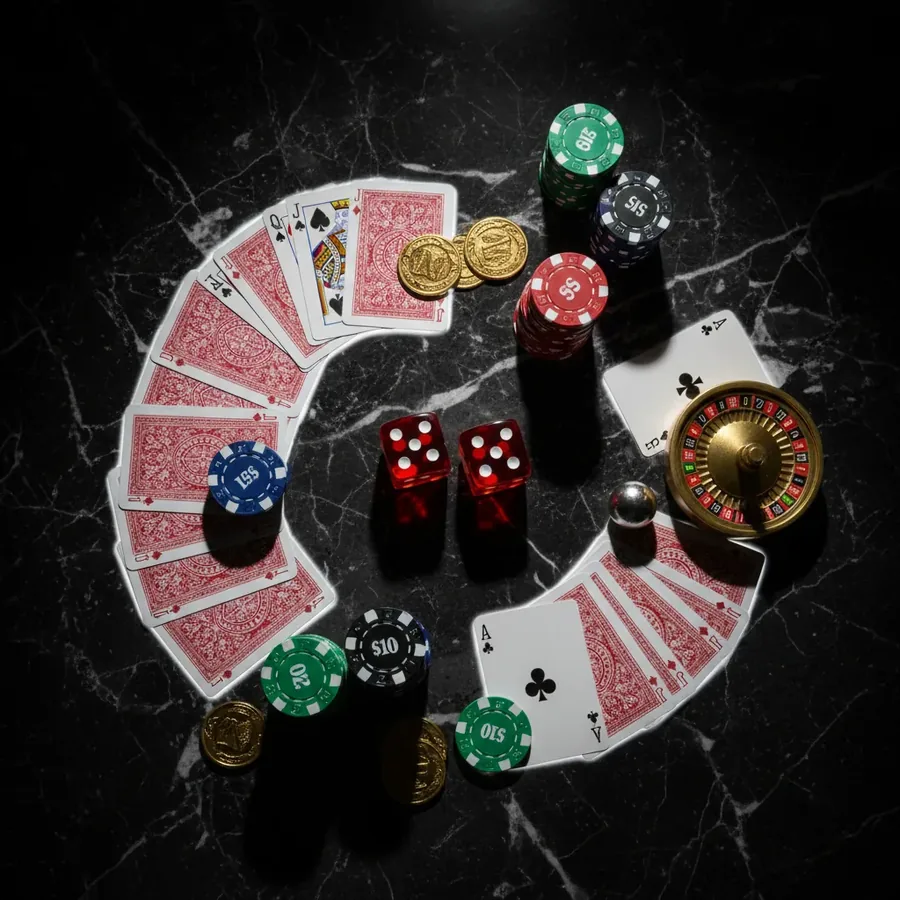
Baccarat in Three Steps: Bet, Reveal, Compare
Baccarat Player with 8 decks carries an RTP of 98.76% and a house edge of 1.24%, paid as a straight 1:1 win with no commission. The three steps are simple: a stake is placed on Player, Banker or Tie, two cards are revealed for each side, and the higher total is compared under fixed drawing rules. The Player bet returns one unit for every winning unit, with no deduction from the payout.
The Banker bet remains the better choice even with its commission, because the Player edge is 0.18 percentage points higher than on Banker. A player staking 100 € on Player can expect to lose 1.24 € on average, while the same amount on Banker keeps less for the casino. The comparison step therefore matters not only for the cards but also for the bet selection before the reveal.
The Tie bet with an 8:1 payout is the worst main bet in Baccarat, with a house edge of 14.36% and an RTP of only 85.64%. On a tie, Banker and Player stakes are returned as a push, but the Tie bet itself loses heavily over time. A 100 € Tie stake costs 14.36 € on average, which is more than eleven times the cost of the Player bet at 1.24%.
Multi-Hand Blackjack: Up to 5 Hands
Multihand Blackjack with up to 5 hands changes the exposure per round, but the underlying maths for each hand follows the same rule set. In Blackjack 6 decks with S17, DAS, DOA and a 3:2 payout, the house edge is 0.46% with basic strategy, and every hand played carries that edge separately. Five hands at 10 € each means 50 € at risk per round, with the same 0.46% applying to the combined stake.
The single-deck classic game with 3:2 lowers the house edge to 0.15%, which is lower than the 0.46% of the six-deck game. Fewer decks reduce the edge by about 0.48 percentage points compared with 8 decks, but a 6:5 payout can erase that advantage. In multihand play, a 6:5 table would apply the 12 € blackjack payout to every hand, multiplying the 3 € shortfall across up to five spots.
Splitting is available up to 4 hands, and split aces usually receive one card each, while doubling after a split improves the return by about 0.14 percentage points. With five starting hands, a player can face multiple split and double decisions in a single round, each requiring an additional stake. The combined cost of five 10 € hands is 2.30 € on average under the 0.46% edge, before any doubles or splits are added.
When to Surrender 16 Against a 10
Late surrender is a rule modifier that improves RTP by about 0.08 percentage points, and the player gives up the hand after the dealer has checked for blackjack, losing half the stake. A 16 against a dealer's 10 is the classic surrender spot in Blackjack 6 decks with S17, DAS and DOA, where the house edge is 0.46% with basic strategy. Surrendering returns 50% of the stake instead of risking a full loss on a weak total.
Early surrender would be worth much more, up to −0.6 percentage points, but it is extremely rare compared with late surrender. The 0.08 percentage point improvement from late surrender means a 10 € stake saves 0.008 € on average per decision, but the real value is avoiding the full 10 € loss when the dealer has a strong upcard. The rule is only available after the dealer checks for blackjack.
The Liberal Vegas Strip rule set includes late surrender alongside S17, DAS and resplit, producing a house edge of 0.28% and an RTP of 99.72%. Against that baseline, the six-deck game with 0.46% costs more per 100 € staked: 0.46 € versus 0.28 €. A player facing 16 vs 10 should surrender when allowed, because the half-stake loss is cheaper than playing out the hand.
How a Blackjack Hand Plays Out: Cards, Decisions, 3:2 Payout
The Blackjack flow starts with two cards and a decision to hit, stand, double or split, with the payout set at 3:2 for a natural blackjack in the classic rule set. The single-deck game with classic rules and 3:2 has an RTP of 99.85% and a house edge of 0.15%, the lowest among the listed Blackjack variants. A 10 € blackjack pays 15 € at 3:2, while a regular win pays 1:1.
In the 6-deck game with S17, DAS, DOA and 3:2, the house edge is 0.46% and the RTP is 99.54%, provided the player follows basic strategy. Dealer hitting soft 17 would add 0.22 percentage points to the edge, while doubling after a split subtracts about 0.14 percentage points. The payout remains 3:2 for a natural, but the rule modifiers around it change the long-run cost of each 100 € staked.
The 6:5 payout variant replaces the 3:2 blackjack payout, raising the house edge to 1.85% and cutting RTP to 98.15%. On a 10 € bet a blackjack pays 12 € instead of 15 €, a difference of 3 € on a single hand. The change adds exactly 1.39 percentage points to the casino's edge, more than any other rule change, and it affects every natural blackjack in the session.
Game categories at a glance
| Category | Examples | Stakes From | Highlight |
|---|---|---|---|
| Slots | Jammin' Jars, Mental, Rise of Olympus | 0.10 EUR | thousands of titles |
| Table games | Roulette, Blackjack, Baccarat | 0.50 EUR | classic rules |
| Live casino | Mega Roulette, XXXtreme Lightning Roulette | 0.20 EUR | real dealers |
| Jackpot games | Mega Moolah, Divine Fortune, Age of the Gods | 0.20 EUR | progressive pools |
| Instant games | Aviator, Plinko, Mines | 0.10 EUR | fast rounds |
| Video poker | Jacks or Better, Deuces Wild | 0.25 EUR | strategy based |
Sic Bo Payouts From 1:1 to 180:1
Sic Bo special bets run from an RTP of 81.48% up to 92.13%, which means the house edge on these wagers spans 7.87% to 18.52%. That is the widest spread of any bet group on a Sic Bo table, and it sits entirely on the optional side bets rather than the main wagers. A player staking €100 across these special bets gives up between €7.87 and €18.52 on average.
The best of the group is the Single Number bet at a 7.87% house edge, and the worst is the Specific Double at 18.52%. Between them sit Any Triple at 13.89%, Specific Triple at 16.20% and the Two-Dice Combo at 16.67%. A side bet is an optional extra wager placed next to the main bet, so these figures apply only when that extra stake is actually made.
Payouts scale with the difficulty: a Specific Triple returns 180:1, Any Triple 30:1, a Specific Double 10:1 and a Two-Dice Combo 5:1. Single Number pays 1:1, 2:1 or 3:1 depending on how many dice match the chosen number. The 180:1 headline carries a 16.20% house edge, so €100 staked there costs €16.20 on average over the long run.
Dozen 2:1 Hits 12 of 37 Numbers
A dozen bet in roulette pays 2:1 and covers 12 of the 37 numbers on a single-zero wheel. Twelve winning pockets out of 37 give a hit rate of 32.43%, while the payout of 2:1 would require 33.33% to break even. The gap between those two figures is exactly the house edge the wheel keeps.
On the American wheel, the same 2:1 dozen payout covers 12 of 38 pockets, a hit rate of 31.58%. The extra double-zero pocket widens the shortfall and raises the house edge to 5.26% against 2.70% on the European layout. Over €100 of dozen bets, that difference is €2.56 more lost on the American table.
The Five Number Bet on the American wheel is the extreme case: it covers 5 of 38 pockets and pays 6:1, which produces an RTP of 92.11% and a house edge of 7.89%. That is the only bet on the American layout with an edge above 5.26%, and it has no equivalent on the European wheel, where the dozen bet stays at 2.70%.
Straight, Split, and Corner: Three Terms Briefly Explained
A straight bet covers a single number and pays 35:1, a split covers two adjacent numbers and pays 17:1, and a corner covers four numbers and pays 8:1. On a single-zero wheel each of the three carries the same 2.70% house edge, because the payout shortfall scales with the number of pockets covered. The straight is the highest variance of the three.
The arithmetic is visible in the coverage: 1 of 37 pockets for the straight, 2 of 37 for the split, 4 of 37 for the corner. The payouts of 35:1, 17:1 and 8:1 fall short of the true odds by the same margin in each case. That is why moving between these three bet types changes volatility but not the expected cost per euro staked.
On the American wheel all three shift to a 5.26% house edge, since the layout holds 38 pockets instead of 37. The Five Number Bet is the exception there, covering 5 of 38 pockets at 6:1 for an RTP of 92.11% and a 7.89% edge. A €10 straight bet on the European layout returns €360 on a win, against €350 at 35:1 on a stake of €10.
The Craps Odds Bet: 0% House Edge
The Free Odds bet is the only wager in the casino with a house edge of 0.00%, because it pays at true odds. It can only be placed on top of a Pass Line or Don't Pass bet once a point has been set. Points of 4 or 10 pay 2:1, 5 or 9 pay 3:2, and 6 or 8 pay 6:5, matching the real probabilities of each point.
Combined with a Pass Line bet in the 3-4-5x mode, the overall RTP is 99.63% and the house edge is 0.37%. Per roll the combined figure is 0.111%, which rises to 0.251% at 1x odds and falls to 0.180% at 2x odds. The Pass Line alone carries a 1.41% house edge, and the Come bet has identical maths.
The Don't Pass bet is slightly better than the Pass Line at a 1.36% house edge, because 7 wins and 12 is a push. Its standard deviation is 0.99 per resolved bet, against 1.00 for the Pass Line. A player who adds 3-4-5x odds to a €10 Pass Line bet cuts the blended cost of the combined wager to €0.037 per €10 staked.
Jacks or Better: Check Payout Table Before Betting
Jacks or Better 9/6 (full pay) with optimal strategy returns 99.54% RTP, leaving a house edge of 0.46%. The house edge is the average share of each stake the casino keeps over the long run. A €100 stake therefore costs €0.46 on average, which is lower than the 1.85% edge on 6:5 blackjack but higher than the 0.15% edge on single-deck blackjack.
The payout table sets 9/6: a Full House pays 9 and a Flush pays 6 per 1 coin. The Royal Flush pays 800, or 4,000 when the maximum bet of 5 coins is placed. A Straight Flush pays 50, Four of a Kind 25, a Straight 4, Three of a Kind 3, Two Pair 2, and Jacks or Better 1.
Standard deviation on this game stands at 4.42, far above the 1.15 recorded on liberal Vegas Strip blackjack. That is the measure of how widely results swing around the average, so a session can deviate sharply from the 99.54% figure. The RTP is a theoretical long-run average over hundreds of thousands of spins, not a forecast for any single session played with the 300% welcome bonus up to €2,000 plus 100 free spins.
Doubling Down: Twice the Stake, One More Card
A Blackjack double down lets a player double the original stake and receive exactly one additional card. The rule effects show that doubling after a split improves the return by about 0.14 percentage points, a meaningful shift for a game where the liberal Vegas Strip version already sits at an RTP of 99.72%. The cost of using this option is the extra stake, but the single card is the trade-off.
In the six-deck standard rules with S17, DAS and DOA, the RTP reaches 99.54% with basic strategy, and the house edge falls to 0.46%. The double down is available on any first two cards in that ruleset, which is the DOA condition. A player staking €10 who doubles puts €20 in play for exactly one more card, with no chance to hit again.
The rule modifier H17 adds 0.22 percentage points to the house edge, while resplitting aces improves the return by 0.08 percentage points. Doubling after a split is worth about 0.14 percentage points, making it one of the stronger player-friendly adjustments. Compared with the 6:5 blackjack payout that adds 1.39 percentage points to the casino edge, the double down rule remains a far smaller effect.
Punto Banco: 5% Commission on Banker Wins
Punto Banco Baccarat pays a Banker win at 1:1, but the casino takes a 5 percent commission on each Banker win. The Banker bet with commission still carries a house edge of 1.06%, which is lower than the Player bet at 1.24%. A €100 winning Banker stake returns €195 net after the €5 commission, while a €100 winning Player stake returns €200.
The Player bet in the eight-deck game has an RTP of 98.76% and a house edge of 1.24%, which is 0.18 percentage points higher than the Banker edge even with its commission. The standard deviation for Player is 0.95, so the outcomes are relatively stable compared with higher-variance side bets. Banker remains the better bet despite the 5 percent commission.
The Tie bet offers the worst main-game option, with an RTP of 85.64% and a house edge of 14.36% at an 8:1 payout. On a tie, Banker and Player stakes are returned as a push. For every €100 staked on the Tie, the average loss is €14.36, while the same €100 on Banker loses only €1.06 on average before the commission.
Taking Insurance: The Most Common Blackjack Mistake
Insurance in Blackjack pays 2:1 when the dealer shows an ace and then reveals blackjack. The six-deck S17 game with DAS, DOA and 3:2 payout lists insurance at 2:1 as a side option, but taking it is widely considered the most common basic-strategy error. The main bet already has a house edge of 0.46%, while insurance carries a far worse mathematical expectation.
The liberal Vegas Strip version has an RTP of 99.72% and a house edge of 0.28%, but insurance is not part of that calculation. A player who regularly takes insurance gives back more than the rule improvements from S17, DAS and resplitting combined. The 6:5 payout change adds 1.39 percentage points to the casino edge, yet insurance can be even more costly on average.
The single-deck classic game with 3:2 has an RTP of 99.85% and a house edge of 0.15%, the best listed Blackjack return. Adding insurance to that game removes the benefit of fewer decks and pushes the average loss higher. A €10 insurance bet pays €20 when it wins, but the true frequency of the dealer blackjack makes the side bet a losing proposition over time.
Craps Pass Line: 1.41% House Edge
The Craps Pass Line bet has a house edge of 1.41% per resolved bet, with an RTP of 98.59%. The Come bet has identical maths, so the same edge and return apply. The standard deviation is 1.00, which places Pass Line outcomes in the middle of the volatility range among the table games listed.
Per roll, the Pass Line edge drops to 0.42%, because the bet often takes multiple rolls to resolve. The Don't Pass bet is slightly better, with a house edge of 1.36% and an RTP of 98.64%, because 7 wins and 12 is a push on the bar rule. A €100 stake on Pass Line loses €1.41 on average, while the same €100 on Don't Pass loses €1.36.
Adding Free Odds in 3-4-5x mode changes the picture: the odds portion has a 0.00% house edge and pays at true odds. The combined Pass Line plus 3-4-5x odds has a house edge of 0.37%, and the per-roll combined edge is 0.111%. That makes the Pass Line with odds one of the lowest-edge bets in Craps, far below the 1.41% of the base bet alone.
Contact
Live - online chat
Banking









Providers












Christchurch Casino 2026